
I Wasn’t Going to Go, and Then It Ended Up Being Inspiring.
Why getting strong-armed into seeing the Uffizi Gallery was a really good experience.

I originally started writing this piece while I was in Florence, but as I explain in the first paragraph I was busy, and am just now getting back to it.
-
Greetings folks! I’m sitting here on the steps of Basilica di Santa Croce in Florence, Italy. I know I’ve been a bit MIA of late, on account of being in Europe and trying to “Euro-max” my time away from home. Apart from the mountains of incredible food available (of which I’ve been consuming great quantities) both Germany and Italy have provided numerous points of inspiration for my worldbuilding.
Today I visited the Uffizi. Which, if you are as clueless about art history as I am, is the art museum in Florence. Oh there are lots of museums about art. But this is the biggest and most famous. I wasn’t even aware of it until my German bestie figuratively twisted my arm, insisting that I HAD to go. By her logic, there are just some things you have to do in certain places. Okay, okay, I went.
And my synopsis? I’m glad I did go. Disclaimer, I only spent two hours there and it was PACKED with…humans. Like, so gods damn many humans and mainly why I was only there for 2 hours (but also I had a dim sum date with my husband at a tea house to get to). But in my time there, my brain was on overdrive consuming color, form, history, process, and the evolution of art over time.
There are two major levels to the thoughts I had today. I’ll start with the surface stuff, and then the deeper, more ruminated musings.
On the Surface
The very first thing that surprised me was the use of vivid color. For some reason I had this misconception that old art was very drab. That was not the case for many of the works on display. They demonstrated very intense hues of red, blue, green, yellow, occasionally purple. I don’t know all that much about how they made paints long ago apart from finely powdered minerals mixed with oils and lacquers, though it wasn’t difficult to imagine the paint makers carefully grinding lapis, and ochre and cinnabar to create these insanely intense colors that barely fade.
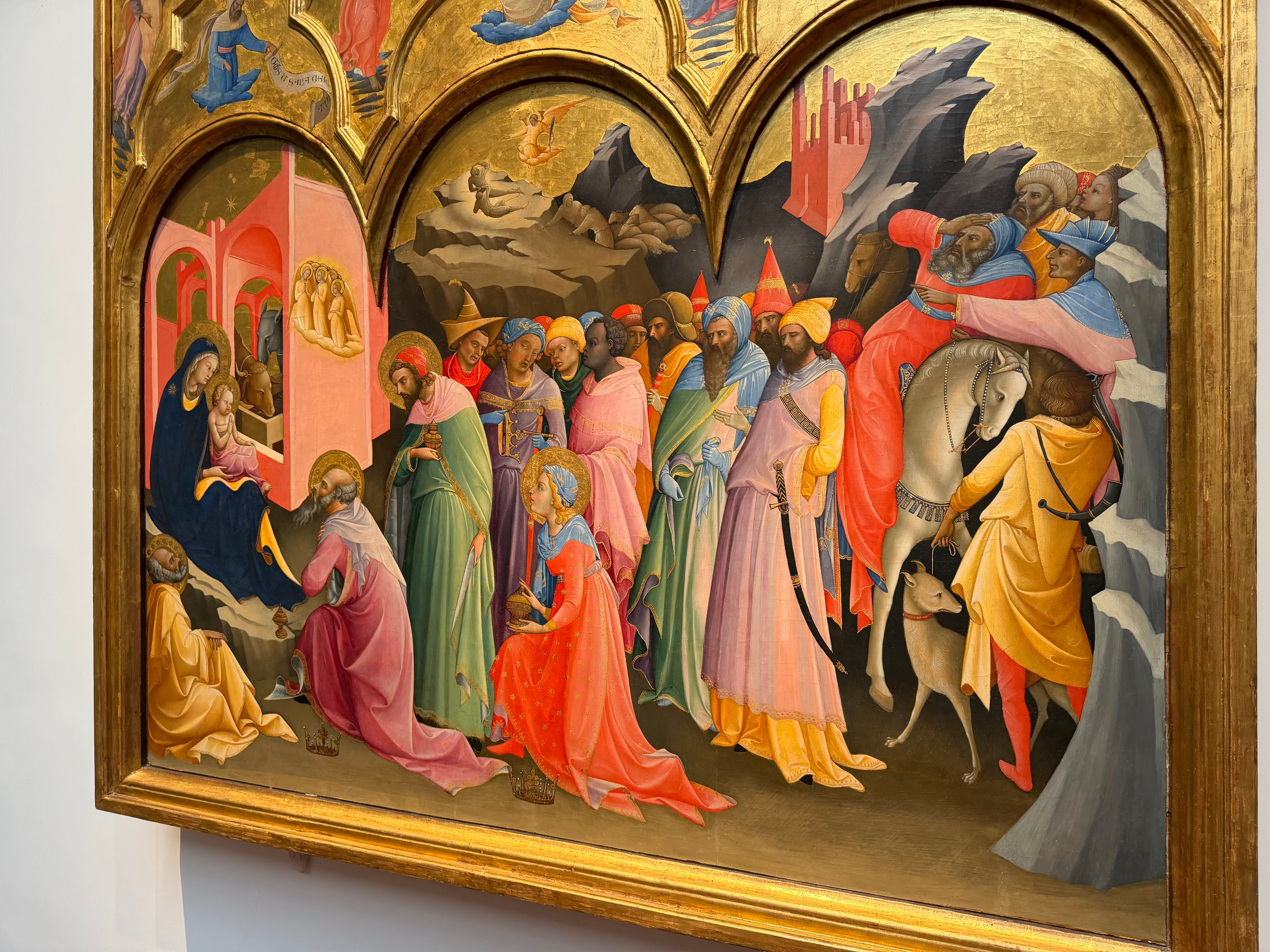
You could also see through the ages how bright colors came in and out of fashion. Again, I don’t know much about art history, but even I could see the pattern. Sometimes the hues almost made me think of the modern world’s use of color in anime and manga. Just, you know, with a totally different style. More on that in a moment.
Another significant observation was the faces of babies and children. Like…wow…um…
Now, my German friend did explain why said faces were so ugly and looked to bad, something having to do with how they were just perceived as small adults, so they stuck adult features on them. Quite frankly, for me, many of them were borderline demonic. Then a new acquaintance I made here in Florence explained that they were capable of making decent looking faces, but they reserved it for depictions of the Christ child. I admit I can see the logic, I just find it…strange.
This last bit, I’m not sure if you would file this as an observation, or a complaint, or a wish. The majority of the rooms I walked through today had incredibly beautiful and complex frescoes adorning the ceilings. And I could not help but hear Queen Latifah in my head from Last Holiday noting that the beautiful ceilings of the fancy-schmany hotel just make you wanna cry. And today I totally understood. I so badly wished for a place I could just lay down and gaze upwards without breaking my neck. Not that that was realistic in this particular establishment, but it almost seems like…a waste…to have such beauty in a place you can barely see.
The Deeper Stuff
If you have read any of my previous posts you may have an inclination of how much I like to think, and ponder, and ruminate. There is a high probability that I was so exhausted after just two hours because of the high octane processing my brain was doing. I tried my best to just enjoy myself, but there was no stopping consuming and digesting a ton of data on all this incredible art. Because I like patterns. And I’m always looking for patterns. And I saw some. And needed to understand them.
What follows is my own interpretation and extrapolation. I haven’t done any specific research, I’m just riffing from previous information I’ve consumed. The “pattern” I was picking up on most was the development of human consciousness across the centuries.
Most of the time, as modern humans, we (wrongly) assume that the conscious experience of being human is the same every and at all times. If you do not assume this, good job. If you do assume this, it’s okay, no judgements. But how any individual experiences the stimuli coming into and being organized by their brain can vary greatly! Art is a perfect example of this.
When you make art, there are two steps happening (probably more, but just go along with me). The first step is taking in the inspiration, stimuli, form, light, sound, etc. It’s the perception part of the equation. This is a combination of physically how your senses work (the quality of your eyesight, the acuteness of your hearing, the sensitivity of your touch, etc), and how your brain organizes that information into a coherent representation that your consciousness can make sense of. It’s important to note that everything we see, feel, hear, touch, taste, is NOT “reality” it is an interpretation of reality.
How we perceive reality is shaped and informed by culture, language, and experience. There is a specific theory for this. The Sapir-Whorf theory states that the language we learn to speak shapes how we perceive the world. Modern linguists have largely debunked this theory, however a softer version, linguistic relativity, continues to hold true. In this scenario, language gently guides and informs perception rather than entirely structuring it out right. Basically any individual can understand any complex concept in any language, but the steps to build the concept and the nuances of it may be slightly different.
Part of this conversation, that I believe continues to hold true, is the way language, culture, and perception are a 3-way dance with one another. And all three are influenced by place, geography, biome. A desert culture may have more words for types of stone, terms for processing stone, uses for stone in everyday life, color palettes informed by available mineral and biological dyes, etc. An island culture might have the same skew in the direction of water knowledge, marine science understanding, a different color set, different linguistic skews. As I always say “nothing exists in a vacuum.” And that comes across so hard when talking about human perception.
The second part of the “art making process” is how those perceptions are then moved out of the mind space and into the real world. The connection between the brain and the movements the hand makes with brush, chisel, or pen. The intimate understanding of the physical properties of a medium and how to effectively use it to communicate a specific concept. And of course the understanding of how to represent form, light, color, and perspective in said given medium. Walking through the (mostly) chronologically ordered art exhibits really drove home how all of these facets advanced and changed over time. It took generations of artists to develop the understandings of how to represent certain forms combined with certain hues to create the illusion of depth and distance. Changes in scientific understanding could lead to different chemical compositions of paint, and preservation techniques. And as one artist spends their life perfecting certain physical sculpting/drawing/painting skills, even when they die, they impart some of their steps forward into their pupils who continue the journey.
I just think this is all fascinating. It’s beautiful. Also, please note, that “forward momentum” doesn’t always look like a straight line moving in one direction. That isn’t really how life works. It’s more just evolution. Things keep changing, adding to, removing from…and it creates history and our perception thereof.
[Continued on June 2nd]
Art and Worldbuilding
Depending on what kind of fantasy/sci-fi you are writing, you may or may not find this realm of material useful. Or relevant. Or even interesting. However, I invite the detail-oriented amongst you to consider the kind of art your imaginary races are making and the history of said art. By and large you can probably get away with never talking about your world’s art history, or simply copy styles from the real world. But if you really want to go that extra mile and produce races and cultures that feel truly unique, consider their art.
This is precisely what my experience at the Uffizi has me thinking about. (Like I need yet another thing to think about.) Having gone through the trouble of creating a unique evolutionary tree of life, it seems like it would dishonor the material I have already come up with if I didn’t give at least some attention to the aesthetics that could naturally arise on Zeer’s six planes.
I’ll use the area of the Water Plane I have been working on lately as an example. For Project You Lick, I have a monsoon-esque subtropical highlands region flanked by rivers. If it were Earth, I’d imagine it looking like certain parts of India, with rich red clay banks cut by flowing water, with tall grasses, and a mix of open forest, dense forest clusters, and maybe some grasslands. And from there I was starting to imagine the ogres living there having architecture reminiscent of India.
But this isn’t Earth. It’s Zeer. It’s the Water Plane. Its wettest and driest are more wet than what you would find in the India-equivalent. The foliage has a different color because because of the different type of star the planet orbits. The organisms living there are utterly different. And ogres don’t have the same requisites for daily life as humans. So why would their art, architecture, fashion, foods resemble India?
It’s certainly possible that through some form of convergent cultural evolution they might have a similar vibe based on environmental influences. Though feels even more possible that the ogres will have their own unique aesthetic practices. The apex predator in their region will shape their mythology. The pigmentation colors available from various organic and mineral sources will effect the colors they use. Throw in their ability to manipulate water and stone as extensions of themselves and they open up a whole set up carving techniques impossible for us magic-less humans.
And perhaps you don’t have to go back and create a whole art history for any given race. But if you might find yourself in need of a city that has been around for a long time and would like to describe different sections and layers based on the differences in their architectural and decorative stylings, then it might be useful to have some kind of understanding.
Anyways. That’s where I’m at. An art museum that I wasn’t even going to visit ended up opening an whole big can of worms for the ol’ think juices. And yes, I’m glad for it.